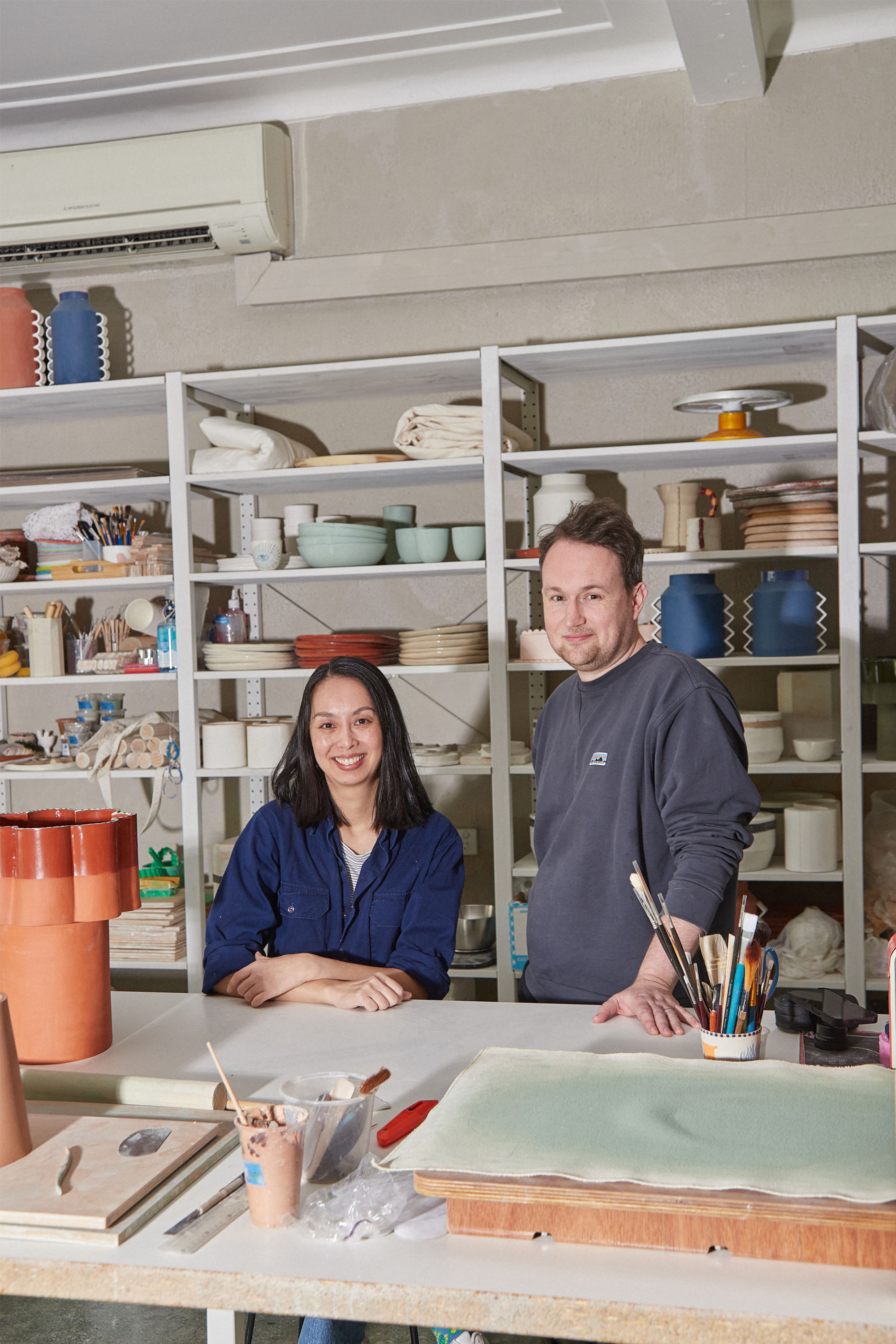
Meet the Maker: Object & Ceramic Design
15.12.25
Based in Marrickville, Object & Ceramic Design is a collaborative ceramic project that blurs the line between art and design. Focusing on small-batch, hands-on production with stained stoneware clay, Susan Chen and Luke Clifton create future heirlooms for both special occasions and everyday rituals. We connected with them to discuss their latest collection for Jardan and their philosophy of slowing down and making with intention.


Can you walk us through your process of making a piece from your collection for Jardan, from idea to finished object?
Susan: The inspiration for this collection is the poetic notion that gold comes from the tears of the sun. Each piece is designed to radiate, both in form and motif. And while they look playful, realising these designs meant resolving several technical challenges, such as the gravity-defying scallops on the spoon rests.
The objects in this collection are all a mix of slipcast and hand-built elements. They touch nearly every tool in the studio at some point, from the slab roller and extruder, to various custom cutters and press moulds we've had to make specially for this collection. Each piece undergoes several stages of finishing, including an engobe base, hand-painting and sgraffito, before being bisque-fired and glazed.
What inspires you the most when creating?
Luke: We are both fascinated by folk vernaculars and modernist form. I love interpreting symbols imbued with ancient magic, motifs that remind us of all the wonders of being alive and connect us to our shared history. It can be as simple as the banded arches on our Monument vases, referencing the architecture of holy places, or the more intricate representations in this latest collection that draw on ancient creation mythologies.
Susan: It becomes interesting when we apply these motifs to simple, contemporary volumes inspired by enduring architectural forms. Architecture has always been a great inspiration for me. I'm always thinking about the shapes we inhabit, the shapes we surround ourselves with, and how they affect the way we feel.


How do you approach creating pieces that are both beautiful and functional?
Susan: Honestly, a function (or potentially a curse) of my background in industrial design is that I always approach design from the angle of utility. For example, the mug handles in this series, while appearing whimsical, perhaps even counterintuitive, are unexpectedly ergonomic. The narrow upper section resists pivoting, which actually reduces the effort required to keep the mug level.
Luke: On the aesthetic side, we try to create pieces that speak to each other across collections, even if they look different at first glance. A kind of managed eclecticism. We keep returning to key principles: geometric architectural forms, a celebration of the raw material, and motif as occasional points of emphasis. I hope this allows people to build collections that connect in visually interesting ways.
Which shapes or silhouettes have resonated most with your audience?
Susan: Since their inception, the Monument vases have struck a chord. We've actually had people walk past the studio while we're making them, stop, come inside, and try to buy them on the spot. I think the main reason is that people can instantly recognise its presence. They work equally well as a sculptural object and as a functional vessel.


How do you incorporate sustainability and longevity into your work?
Luke: Everything we make or consume has an impact; there is no running away from that. Since shipping is responsible for a massive portion of global emissions, the most effective way to reduce our environmental impact is to manufacture locally… which obviously, we do! Jardan's commitment to local manufacturing and support for local makers makes them a great partner and a perfect fit with our own philosophy.
Susan: From a material perspective, clay is inherently recyclable. We minimise waste by recycling raw clay and grinding down unsuccessful fired pieces to create grog (which can be added to clay, changing its texture). From a design perspective, we focus on longevity. Our pieces are designed to work together aesthetically, so you can add to your collection over time knowing that any new piece will complement your existing pieces.
What has surprised you most since launching OCD?
Susan: Ceramics can be a solitary activity. However, deciding to set up our space on the high street, combining our studio, workshop, and store, created a lovely sense of community that I didn't expect. People can witness and even participate in what we are doing. And of course, Addison Road in Marrickville has become a real home for local creatives. I think we plugged into that at just the right time.
Luke: Having our studio across the road from a pub is also kind of great.


How does food and connection influence your creative process?
Susan: Growing up in an immigrant family, celebrations were always shared experiences centred around food. In those moments, the "good" tableware was brought out, the fancy platters, the special plates. The objects themselves spoke to the importance of the occasion without saying a word. It is so special to create pieces that will be used to mark important occasions or celebrate the everyday ritual of sharing a meal with loved ones.
Luke: Exactly. We want to create future heirlooms imbued with meaning, design pieces with longevity that will be passed onto the next generation.


What's next for OCD?
Susan: OCD was always meant to be a vessel for experimentation where we can play with the boundaries between design, art, and craft. We hope to keep creating pieces people will treasure, and we'll continue to do that as long as we can get away with it!


